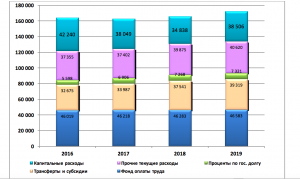
In 2016-2019 the average increase in total state budget expenditures is projected to be 106.8%. At the same time, in 2017, total expenses are decreasing relative to 2016 and will amount to 99.2%, with further growth in 2018-2019, 102.0% and 103.9%, respectively. Operating expenditures in this period are projected to grow by an average of 3.2% annually in 2017-2019, and capital expenditures are projected to decline by an average of 9.2% in 2017-2018 and grow by 10.5% in 2019. This is due to a decrease in the parameters of macroeconomic indicators, as well as the forecast for budget revenues.
As Diagram 1 shows in the period 2013-2016. the total expenditures of the state budget are dominated by the wage fund (about 30%) and other current expenses (over 25%), transfers and subsidies – about 22.9%, and capital expenditures from 2013 to 2016 increased from 11.5% to 25.8%. Payments on public debt during this period are within 3.0% of total government spending.
Projected for the period 2017-2019. the data will slightly change the structure of expenditures on economic items. Thus, by 2019, the wage fund will decrease to 27.0%, other current expenses will increase to 23.6%. Capital expenditures in 2017 will amount to 23.4%, decrease to 21.0% in 2018 and increase to 22.3% in 2019 of total state budget expenditures. Transfers and subsidies will increase from 20.9% in 2017 to 22.8% in 2019, which is due to the projected increase in transfers to the Social Fund, so in 2017 transfers increased by 1.3 billion soms, in 2018 – by 3.6 billion soms, in 2019 by 1.8 billion soms. Payments on public debt in 2019 will increase to 4.2% of total spending or 1.2% of GDP.
Diagram 1. Dynamics of the state budget by economic items of expenditure.