



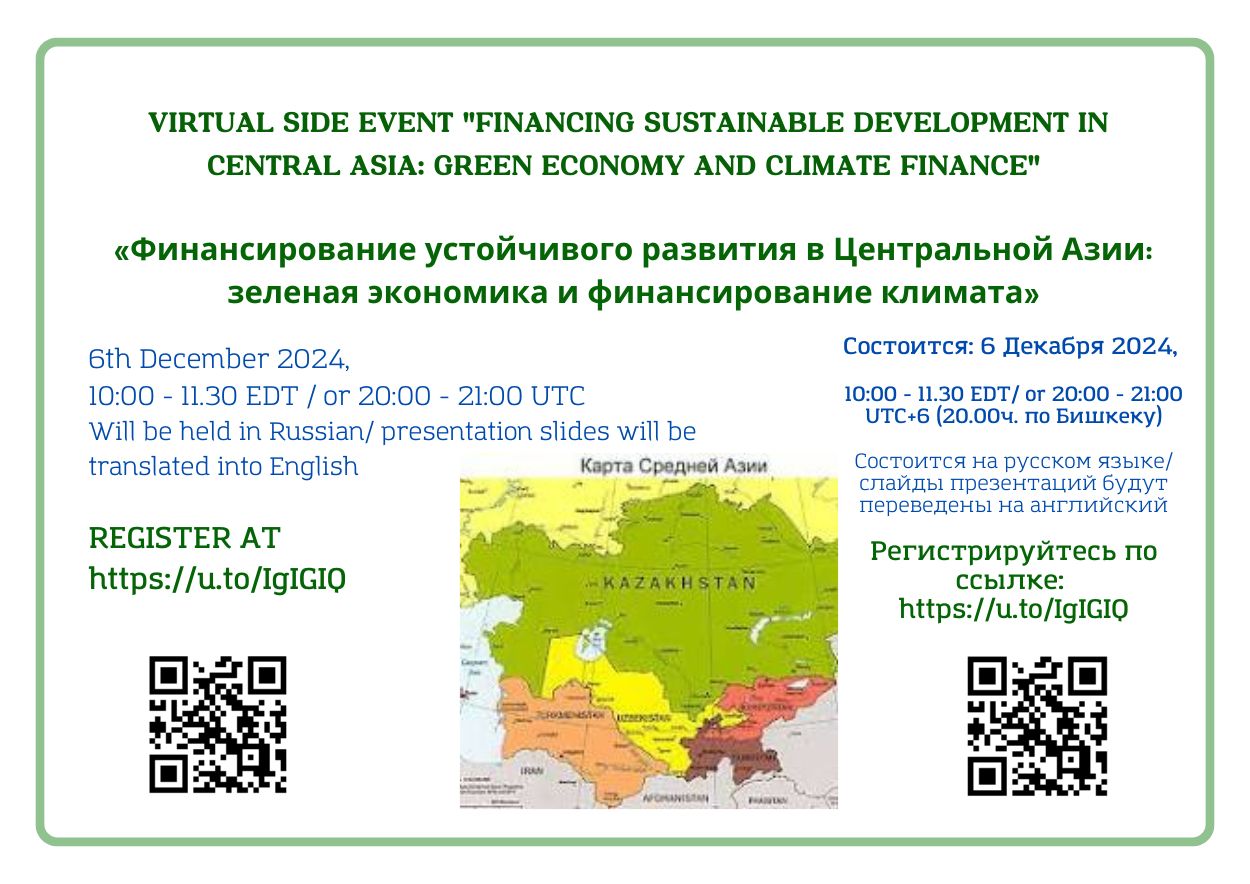
On December 6, 2024, PF Nash Vek, together with the External Aid Monitoring Group, organized and held a side event: “Financing sustainable development in Central Asia: green economy and climate finance.”
A video of the side event can be found below:
Recommendations based on the results of the side event:
| Key strategies for financing sustainable development in Central Asian countries: Financing sustainable development in Central Asia (CA) requires a comprehensive approach that takes into account the region’s characteristics, such as limited water resources, climate change, economic dependence on primary industries and socio-economic inequality. |
| Attracting international funding: – Global funds: Active participation in international initiatives such as the Green Climate Fund (GCF), the Global Environment Facility (GEF), and the United Nations Development Program (UNDP). – International development banks: Receiving grants and loans from the Asian Development Bank (ADB), the World Bank, the European Bank for Reconstruction and Development (EBRD), etc. – Bilateral cooperation: Attracting funding from donor countries through technical and financial assistance programs. – Swap the debt of countries that are experiencing a peak in payments for green projects. |
| Green economy development: – Investments in renewable energy: Incentivize solar, wind and hydropower projects. This will reduce dependence on hydrocarbons.- Energy efficiency: Implementation of programs to modernize infrastructure to reduce energy losses. – Sustainable Agriculture: Financing projects to introduce water-saving technologies and sustainable farming practices. Water as a resource should be at the heart of all decisions made in all sectors of the economy, that is, the efficient use and preservation of water purity. In green financing, it is necessary to take into account small businesses in the regions and be accessible to rural residents. Take into account the NEXUS approach in the green economy as European experience. |
| Public-private partnership (PPP): – Creation of conditions for attracting private investors in environmental and social projects. – Introduction of tax incentives and subsidies for companies that invest in sustainable development. – Development of a legislative framework for the effective implementation of PPP. |
| National budgets and reforms: – Increasing funding for education, health and social protection. – Expanding the tax base by taxing unsustainable practices (such as carbon emissions) and incentivizing green businesses. |
| Development of green finance markets:
– Green bonds: Creation of platforms for issuing bonds aimed at financing environmental projects. – Climate Investments: Attracting institutional investors through specialized funds. – Microfinance: Increasing access of small businesses and farmers to sustainable financial resources. |
| Regional cooperation:
– Coordination of joint initiatives in the field of water resources, energy and transport. – Creation of regional funds or organizations aimed at supporting sustainable development (for example, environmental technologies).
|
A side event/side event entitled “Financing Sustainable Development in Central Asia: Green Economy and Climate Finance” was included in the side event program of the 2nd FFD4 (Finance for Development) Preparatory Committee of the UN.