



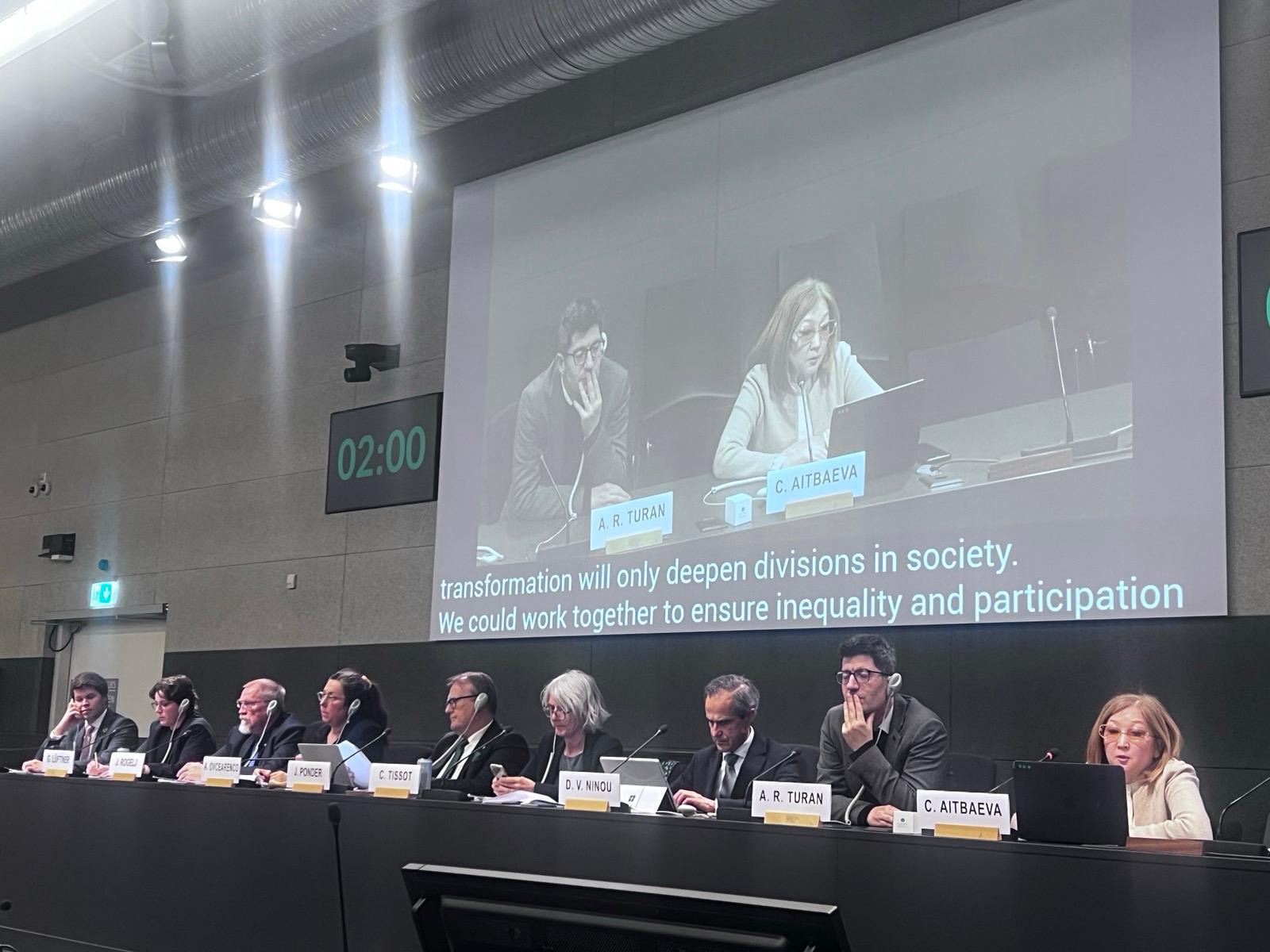
The Regional Forum on Sustainable Development 2026 for the ECE (United Nations Economic Commission for Europe) region was held in Geneva on April 21–22, 2026 under the theme: Transforming Together: Innovative and Equitable Actions to Achieve the SDGs
The Forum’s goal is to accelerate and coordinate action to achieve the SDGs, and maintain momentum for innovative policies and solutions.
The 2026 Sustainable Development Forum aimed to accelerate progress on the SDGs and maintain momentum in developing high-quality policies and solutions.
In line with the 2026 High Level Policy Forum (HLPF), SDG 6 (Clean Water and Sanitation), SDG 7 (Affordable and Clean Energy), SDG 9 (Industry, Innovation and Infrastructure), SDG 11 (Sustainable Cities and Communities) and SDG 17 (Partnerships for the Goals) were addressed.
Activities included:
High-level panels and plenary sessions entitled “Transforming Together: Innovative and Equitable Action to Achieve the SDGs.”
Round tables for the exchange of experience between colleagues on the SDG under consideration.
On April 20, the Forum of the CSO REGIONAL CIVIL SOCIETY PARTICIPATION MECHANISM (ECE-RCEM) was held.
ECE-RCEM is an institutionalized platform for civil society participation in UNECE regional sustainable development processes. By bringing together diverse stakeholders, the platform collaborates on the follow-up and review of the 2030 Agenda, ensuring inclusive contributions to a sustainable future. http://ece-rcem.org
Representatives of PF Our Century participated in all of the above events.




Below is the text of the speech by Chinara Aitbaeva, director of the Our Century Foundation, on behalf of the UNECE regional civil society mechanism at the round table on SDG 17.
http://ece-rcem.org/tpost/5h05a9dmc1-rfsd-2026-sdg-17-roundtable
Thank you, Chairman.
I speak on behalf of the UNECE regional civil society mechanism, which brings together representatives from across the region and 17 different groups.
We want to emphasize: digital transformation is not neutral. Without committed, inclusive and accountable partnerships, it risks exacerbating inequality rather than advancing the 2030 Agenda.
Goal 17 reminds us that partnership is not just about mobilizing resources, but also about issues of power, trust and shared responsibility. Today these principles are under threat.
First, the digital divide is not just a problem of connectivity, it is a problem of exclusion. We see that older people, rural communities and socially and economically discriminated populations are not being prioritized in digital transformation and are being left behind. Sometimes, when digital government services replace physical ones, the exclusion becomes structural: people lose access to banking services, healthcare, and even their rights. There are no appropriate guarantees to protect populations at risk.
Second, we must confront the growing concentration of power in digital ecosystems. Much of the digital infrastructure, platforms and data is controlled by a small number of private companies, mainly from countries in the Global North. This creates dependency, especially for countries in the Global South, and raises a fundamental question: who benefits from digital transformation? Too often the answer is not communities, but profit-driven models that can exploit data without control. As a result, many remain excluded—not because solutions do not exist, but because they are not considered “profitable users.”
Thirdly, in our region there is an infringement of digital rights and civil society. Under restrictions, digital tools no longer promote participation—they become tools of digital control. Entire populations are forced to migrate to state-controlled platforms, where privacy is lacking and dissent becomes dangerous. At the same time, disinformation campaigns, manipulation of algorithms, and even interference in electoral processes are undermining democratic systems around the world.
Fourth, the risks associated with artificial intelligence are growing faster than governance frameworks. Artificial intelligence is already being used in conflict situations—not to protect civilians, but to identify and strike them. This raises urgent ethical and legal questions. At the same time, AI-driven systems are shaping labor markets, often without social protections, transparency or public oversight. We cannot afford a future in which decisions about people’s livelihoods are made by opaque algorithms.
Fifth, we must not ignore the environmental costs of digitalization. Data centers consume enormous amounts of water and energy, often in regions already facing shortages. Without compliance with sustainability standards, digital transformation could hinder rather than support climate goals.
However, there are opportunities – if we build partnerships correctly.
Civil society proposes five priorities:
- Creating inclusive regulatory frameworks.
National and international governance must ensure that digital and AI systems are human-centred, rights-based and transparent. This includes accountability for tech companies and clear standards consistent with regulatory frameworks and international law.
- Investing in digital literacy and inclusion.
Digital access must go hand in hand with digital literacy for all ages and abilities. This requires public investment in education, retraining and outreach, especially for marginalized groups.
- Support for civil society and independent media.
Civil society actors working on issues of digital rights, disinformation and accountability need to be supported, not limited. Partnerships cannot function where civil society is targeted by the state.
- Strengthening dialogue between stakeholders.
Partnerships must go beyond consultation and be based on joint decision-making. Civil society, workers and local communities must have a voice in shaping digital policy at the national and global levels.
- Ensuring ethical and sustainable innovation.
Digital solutions must address environmental sustainability and social well-being, not just efficient growth.
Finally, SDG 17 calls for trust, which must be built through transparency, accountability and inclusiveness. If we don’t make efforts to do this, digital transformation will deepen the division of society.
Joint action can be a powerful tool for promoting equality, inclusion and human dignity.
Civil society is open to collaboration – but this is only possible in a system where partnerships are truly inclusive, rights-based and accountable.
Thank you.
ENGLISH BELOW
Thank you, Chair.
I’m speaking on behalf of the ECE civil society regional mechanism, which brings together representatives from all parts of the UNECE region and from 17 different constituencies.
We want to emphasize a central reality: digital transformation is not neutral. Without intentional, inclusive, and accountable partnerships, it risks deepening inequalities rather than advancing the promise of the 2030 Agenda.
SDG 17 reminds us that partnerships are not only about mobilizing resources—they are about power, trust, and shared responsibility. Today, those principles are under strain.
First, the digital divide is not just about connectivity—it is about exclusion. We heard clearly that older populations, rural communities, and socially and economically discriminated people are not given priority in digital expansion, and are being left behind. Sometimes when digital public services replace physical ones, exclusion becomes structural: people lose access to banking, healthcare, and even their rights. Adequate safeguards are not yet in place to protect at risk populations.
Second, we must confront the growing concentration of power in digital ecosystems. A large share of digital infrastructure, platforms, and data is controlled by a small number of private actors, largely based in the Global North. This creates dependency, particularly for countries in the Global South, and raises a fundamental question: who benefits from digital transformation? Too often, the answer is not communities, but profit-driven models that extract data without accountability. As a result, many stay disconnected—not because solutions do not exist, but because they are not seen as “profitable users.”
Third, we are witnessing across our region an alarming erosion of digital rights and civic space. In restrictive environments, digital tools are no longer enabling participation—they are enabling surveillance. Entire populations are being pushed onto state-controlled platforms, where privacy does not exist and dissent becomes dangerous. At the same time, disinformation campaigns, algorithmic manipulation, and even interference in electoral processes are undermining democratic systems across borders.
Fourth, the risks of artificial intelligence are accelerating faster than governance frameworks. AI is already being used in conflict settings—not to protect civilians, but to identify and target them. This raises urgent ethical and legal questions. At the same time, AI-driven systems are shaping labor markets, often without social protection, transparency, or human oversight. We cannot allow a future where decisions about people’s livelihoods are made by opaque algorithms.
Fifth, we must not ignore the environmental cost of digitalization. Data centers consume vast amounts of water and energy, often in regions already facing scarcity. Without adherence to sustainability standards, digital transformation may undermine climate goals rather than support them.
Yet, there is also opportunity—if we get partnerships right.
Civil society proposes five priorities:
- Build inclusive regulatory frameworks.
National and international governance must ensure that digital and AI systems are human-centered, rights-based, and transparent. This includes accountability for technology companies and clear standards aligned with regulatory frameworks and international law.
- Invest in capacity and inclusion.
Digital access must go hand in hand with digital and AI literacy—for all ages and abilities. This requires public investment in education, reskilling, and outreach, particularly for marginalized groups.
- Protect civic space and independent media.
Civil society actors working on digital rights, disinformation, and accountability must be supported—not restricted. Partnerships cannot function where civic space is shrinking.
- Strengthen multi-stakeholder dialogue.
Partnerships must move beyond consultation to co-creation. Civil society, workers, and communities must have a seat at the table in shaping digital policies at national and global levels.
- Ensure ethical and sustainable innovation.
Digital solutions must align with environmental sustainability and social well-being—not only efficiency and growth.
Finally, SDG 17 calls for trust. But trust cannot be assumed—it must be built through transparency, accountability, and inclusion.
If we fail to reinforce the act, digital transformation will divides.
If we succeed, it can become a powerful tool for equity, participation, and human dignity.
Civil society stands ready to partner—but only in a system where partnerships are truly inclusive, rights-based, and accountable.
Thank you.